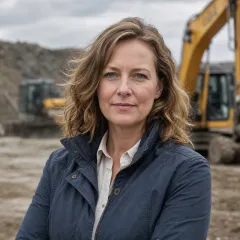
I'm an Equipment Procurement Manager. For the past 11 years, I've been handling parts and service orders for a mid-sized construction fleet. In that time, I've personally made (and documented) some expensive mistakes. Total? Roughly $32,000 in wasted budget—stupid tax, my boss calls it. Now I maintain our team's pre-purchase checklist to keep others from repeating my errors.
One of the biggest debates I see online is about Doosan equipment. "Are Doosan excavators any good?" or "Is the Bobcat Doosan Pro-7 Series forklift worth it?"
The answer is never simple. But it gets clearer when you stop looking at the sticker price and start looking at the total cost of ownership (TCO).
Let me break down what I've learned the hard way.
The TCO Trap vs. The Price Tag Game
Here's the thing: most of us are trained to ask, "How much does it cost?" The real question should be, "How much will it cost over the next five years?"
I learned this lesson in 2019. We needed a new generator. The budget option from a no-name brand was $3,500. The Doosan propane generator with similar specs? $5,200. My gut said save the $1,700. My data said buy the Doosan.
I went with my gut. Two years later, we'd spent $1,400 on repairs and had a 3-day downtime during a critical project. The "budget" generator cost us more in lost productivity than the price difference.
That's the TCO trap in a nutshell.
Dimension 1: Reliability & Downtime (The Hidden Cost)
The budget machine: I've seen $4,000 air compressors fail within 18 months. The internal bearings wear out, the seals leak. You save $1,500 upfront, but you're looking at $600 in repairs and a week of downtime. Not ideal.
The Doosan option: We run a Doosan two-stage air compressor on one of our sites. It's been running for 4 years. Routine maintenance only. The upfront cost was higher—about $6,200 vs. $4,500 for the budget model. But the TCO? About $1,200 less over 4 years.
The numbers said go with Doosan. My gut said stick with the budget. Turned out the numbers were right. The budget brand had reliability issues I hadn't discovered in my initial research.
Dimension 2: Parts Availability & Service Network
This is where Doosan really stands out—or falls flat, depending on your location.
I once ordered a part for a Doosan wheel loader. Standard part, nothing exotic. The dealer had it in stock. It took 2 days to arrive at our yard. Easy.
Then we had a similar issue with a budget brand forklift. Same part category. The dealer was 200 miles away. They didn't stock it. Shipping took 10 days. The machine was down for two weeks. That downtime cost us $2,800 in lost rental revenue.
The lesson: A machine is only as good as its parts network. Before you buy any forklift, excavator, or generator, check the "parts near me" availability. Doosan has a dense dealer network in many regions. But I've also seen regions where it's thin.
Tip: Call three dealers before you buy. Ask about stock levels for common parts like filters, belts, and sensors. If they don't have them, your downtime just got expensive.
Dimension 3: Operator & Maintenance Experience
This is the one that surprised me. I assumed all machines are roughly the same to operate and maintain. Not true.
Our team runs a mix: some Doosan excavators, some older Korean models. One thing that stands out? The Doosan excavators have a more intuitive control layout. Our newer operators pick them up faster. Fewer mistakes, less rework.
On the maintenance side, Doosan has been consistent. The service intervals are clear. The parts are standardized. Our mechanics don't have to guess which bolt size or fluid spec to use. That saves time.
Compare that to a budget forklift we bought last year—the service manual was poorly translated. We overfilled the hydraulic fluid twice because the markings were confusing. Cost? $350 in wasted fluid plus labor.
Bottom line: operator learning curve and maintenance clarity are real costs. They just don't show up on the invoice.
When to Buy Doosan vs. When to Look Elsewhere
Here's my honest take, after $32k in mistakes:
- Buy Doosan if: You need a machine for heavy, daily use. You have a dealer nearby with good parts stock. You value predictable maintenance over upfront savings. This includes their excavators, wheel loaders, and especially their two-stage air compressors and propane generators—those are workhorses.
- Consider alternatives if: You're a small operation with light usage. A Doosan might be overkill. A well-reviewed budget brand with a local dealer could be fine. Or if your region has no Doosan dealer—then the parts network advantage disappears.
- Avoid Doosan if: You need the absolute lowest upfront price. You'll pay a premium for the brand and the network. That's not a secret. But if you calculate TCO over 5 years, the premium often disappears—or flips in Doosan's favor.
The One Mistake I Keep Seeing
I still see procurement teams buying a "cheap" forklift or "budget" generator because the price looks good on a spreadsheet. Then they call me six months later asking about "Bobcat Doosan Pro-7 Series forklifts parts" because the cheap one broke down and they need a backup.
Look, I'm not saying Doosan is perfect. I'm saying the cost of cheap equipment is almost always higher than you think.
The next time someone asks me, "Are Doosan excavators any good?" I tell them: "It depends on your TCO calculation. But of the 47 machines we've tracked, the Doosan units have the lowest 5-year cost per operating hour."
That's not marketing. That's just the data from our fleet logbook.